
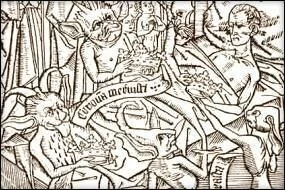
Could demons be our negative thoughts? We tend to think that such an allegory makes sense, especially when considering the 'holes' found in most religious demonology dogma.
Dawnie is right. Consider this: Whenever we think, our thoughts take us to different places. It may be the past, or it may be the future; but most of the time our thoughts take us to a place that is not the present. And the present moment is what is real. Now is real. Could thoughts that sweep us away from being in the reality of 'now' actually be demons?
We were impressed with Rosemary Guiley's definition of "demon" in The Encyclopedia of Ghosts and Spirits, being pleasantly surprised to see she did her research with regard to the word's origin and the connection with Greek beliefs in daimones:
Demon - The term 'demon' means 'replete with wisdom' and is derived from the Greek word DAIMON, which means 'divine power,' 'fate' or 'god.' Daimones were rather like guardian spirits to the Greeks.
This has been the point we have been trying to share within our demon section of articles: Demons did not exist before or during the time of Christ as evil beings out to get us. The demon idea was created as a doctrine by religious leaders, evolving over the past two thousand years into what many have come to believe, today. For more on this topic, read Demons & Ghosts.
Just because we were led to believe traditional teachings about demons are true does not make this teaching fact. Think about this: We know that fear, in some form, is the basis of things negative and hurtful; so why would those who profess to have spiritual wisdom, meaning some religious leaders, fill the minds of people with fearful ideas? Those who do so promote fear to gain control over the minds of those who give them an ear.
The Spirit Realm
I would suggest that the spirit realm co-exists with the physical. The idea of heaven and hell being right here on earth is correct if one looks at heaven and hell as being "states of mind" or one's inner condition. From that perspective earthbound spirits (ghosts) who are held here in emotional/physical trauma are in "hell," mentally and emotionally. Looking at heaven and hell as simply terms used to convey the healthy and unhealthy mental condition, in no way destroys the belief in an afterlife. In fact, I would argue that it strengthens the truth of the eternal spirit within all. Read more about the Spirit World.
Spirits and ghosts are all around us, but do not let that idea cause your mind to wander into fear. Simply know that all of us are connected in spirit, and both ghosts and spirits interact with our world more than we know. I use the term ghost only to define the spirit of a person who is temporarily lost. We could easily find many people in bodies who are just as lost, living for today and lacking love and light. Will their condition be any different when their physical bodies become dust? Somehow, a change of thinking must take place within those who are lost to bring them into peace, freedom, love, and joy.
Negative Thoughts: Changing Our Minds
Let us assume that Jesus possibly had the know-how to free people. Writings about him profess that he spoke adamantly about "repentence." Most of us think that means to beg for forgiveness but actually it is better understood as 'to change one's mind.' When we think differently or, better yet, stop thinking, change occurs. Jesus didn’t attack ghosts (spirits of hurting people) or banish them, but the gospels read that he “rebuked” the ghosts. Religious teachers will incorrectly teach that to rebuke is to 'cast out,' essentially saying, “Get out of here bad person!” However, to rebuke better means 'to instruct.' Therefore, when Jesus rebuked demons, he was having discussion with them, enlightening them in an attempt to free them from their own personal hells. Now that you know what rebuke means, what we read Jesus did sounds more like an attempt at healing hurting people and less like the banishment of scary monsters. Not to sound religious but the following is a passage that is a parable Jesus is said to have spoken:
"Settle matters quickly with your adversary who is taking you to court. Do it while you are still with him on the way, or he may hand you over to the judge, and the judge may hand you over to the officer, and you may be thrown into prison. I tell you the truth, you will not get out until you have paid the last penny." - Matthew 5:25-26
The religious would tell us that the judge in the above passage is 'God,' but we would offer that the true judge (and our adversary) is our own conscience. When we wrong others, we bring our own self-condemnation (call it judgment) upon ourselves. We subconsciously set the price we must pay, then, we assign ourselves just penance. Yes, we effectively and unwittingly bring our own punishment until we feel we have paid the entire price for our wrong doing. It may not happen in this lifetime but make no mistake: You cannot hide guilt and shame; it will come forth in the future when you are ready to face it. And, this is hell: a self-created prison of the mind created through what we believe to be our own sins (mis-thinking, to miss the mark, a correctable error).
We may not know it, but we are our own harshest critics, and fear is the basis of our self-condemnation and unforgiveness. Fear must be sleign for us to ever be free. The only way to find freedom from the false, the self-created prison of the mind, our personal hell, was best stated over 2000 years ago:
“And you shall know the truth, and the truth shall make you free.”
Knowing the truth about who we are, our oneness with each other, our existence within the all-encompassing eternal spirit of which we are all part, is the path to freedom. Slay your demons (fearful thoughts) and peace will be your friend.