

 Making a Camera to See Ghosts: Converting and Using an IR Digital Camera for Ghost Hunting
Note: We were one of the forerunners in figuring out how to convert point-and-shoot digital cameras to full spectrum back in 2009-2010 when this article was written. At that time, it was an idea we perfected after seeing an initial experiment in conversion.
All of us are aware of color photography which primarily photographs the visible light spectrum, but are ghosts normally found within the visible light? Many ghost photographers would agree that ghosts seem to prefer darkness for cover. There is nothing magical about this. If you want to hide, then you seek cover, and darkness provides the best place to hide. Today, many are attempting to photograph ghosts in darkness by using the regular flash unit. The problem with this is that the bright flash of light is distracting to the ghost investigator, and most likely to ghosts who do not wish to be detected.
The obvious solution would be to use Infrared lighting to covertly illuminate the darkness, while not illuminating it with visible light. To do this, one needs to use a camera capable of Infrared photography - a real ghosts camera! See: Ghost Hunting Camera.
The old-time method for Infrared photography would be to use IR film that is both difficult and expensive to work with. A lower cost solution would be to use a digital camera that is able to see the infrared spectrum of light and record it digitally. Digital cameras have great white light and Infrared visibility (from about 350 -1000 nm), but unfortunately use an IR-cut filter (aka "hot mirror") that blocks out most of the Infrared light. By virtually eliminating infrared light, digital cameras take better color photographs. The IR-cut filter allows only the visible light spectrum to be recorded by the camera's eye (approximately a range of 350-700 nm), spanning from only the upper end of the ultraviolet spectrum (10 - 400 nm), through the visible (380-750 nm), and up to the Infrared spectrum (750 - 1000 nm). See: Full Spectrum Cameras.
Why not consider using a digital camera that is converted to see a broader spectrum for ghost hunting? By doing so, we can allow the camera to see more (potentially from the upper end of the ultraviolet range, completely through both the visible and Infrared spectrum), providing a better opportunity to possibly capture a ghost in our photographs. Though such a modified digital camera should make a great tool for ghost hunting in low-light conditions, it may not be good for daylight situations. It will depend on whether or not you choose to eliminate the visible spectrum. If the visible spectrum is filtered out, you'll have a camera that can take stunning daytime photographs.
But for our ghosts camera, we recommend using an Infrared illuminator for nighttime conditions. This will still allow ghosts the cover of darkness, but illuminate the area for the camera to be able to see what remains hidden to the human eye.
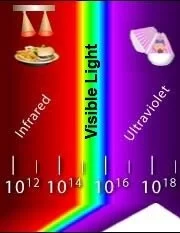 The electromagnetic spectrum is made up of different wavelengths of radiation, from sound to light. Theories abound as to where on the spectrum that ghosts may best be able to be detected. For example, are ghosts and spirits at a lower, or higher vibration (wavelength) than our equipment can capture? If so, then, can we modify our equipment to focus on specific wavelengths to capture paranormal evidence? The chart, at right, shows the primary ranges we are focusing on with full spectrum: Infrared, Visible and Ultraviolet light ranges of the electromagnetic spectrum.
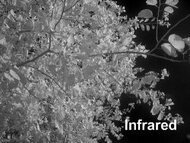
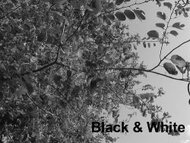
Let's first show you an example of an Infrared photograph as compared to a color, and black white image. The images, below, show the difference between all three. Notice how the sky is dark in the Infrared photograph, while the leaves are shades of white. The black and white photo is an opposite effect, with a lighter sky and darkened leaves.

Modifying Cameras To See Infrared
It is not known as of this writing if all digital cameras can be modified, but it is well-known that the Canon G1 and G2 are able to be converted along with other digital cameras.
To create a camera that can see a broader spectrum of light, you will need to remove the IR cut filter, replacing it with clear optical glass. For the faint of heart, you should know that you can purchase cameras already converted, or simply have your digital camera sent away and modified.
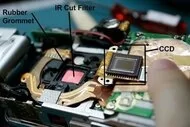 Tearing digital cameras apart and removing the IR filter can be difficult, and one must be sure to re-assemble the camera exactly as it came apart. The basic idea is to carefully remove any covers, wire bundles, or circuit boards that obscure the CCD sensor (the eye of the camera), which when removed will reveal a rubber grommet and the IR cut filter. Typically, after the grommet is removed, the camera can then be tipped upside down to allow the filter to drop out. Now the tricky part. It is sometimes possible to purchase an optically clear piece of glass that will fit back into the space once occupied by the filter you just removed, however it may be necessary to create one yourself. You could purchase optical glass the same thickness as the filter you removed. The optical glass can be cut to size with a glass cutter (score and snap), or it has been reported that glass microscope slides (as well as thinner glass slip covers for microscope slides) can be used stacked together to reach the desired thickness. They can be cut the same way as optical glass. Be sure to smooth the edges, and clean the glass (if using slides, glue them together with a little adhesive. You'll want to use a permanent, biological mounting adhesive designed for making permanent microscope slides to do this such as EUKITT from EMS, or Entellan Neu from Merck) before installing them in your digital camera.
 IR Camera Conversion
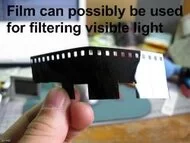
It has been reported that you can trim with scissors a few pieces of developed, unexposed camera film to the exact same size as the IR filter. Re-assemble your camera using enough pieces of the film to duplicate the thickness of the IR filter you removed. This is supposed to effectively block out just the visible light spectrum, turning your camera into an Infrared-only unit. If your camera is reassembled correctly, it should function properly. However, the ghost camera will not be useful for normal color photography, so be sure and have a separate camera to use for regular picture taking.
Additional Notes
Above Photograph: The inside of a Canon Powershot A610 5.0 megapixel camera. After peeling back the foil cover, the CCD unit is exposed. By removing a couple screws, it can carefully be pulled back exposing the infrared cut filter.
Carefully remove the rubber grommet around the filter, and the filter should be able to drop out of the box when the camera is turned upside down. After replacing the filter with either glass or pieces of film, you may need to use some tack, small amount of adhesive to hold the film or glass in place if the grommet cannot be re-used.
Disclaimer: This article is a suggestion, but in no way implies the ideas will work. Angels & Ghosts makes no guarantee, and does not imply that this will indeed work. Angels & Ghosts is not responsible for damages to digital cameras. Camera owners who try this, do so at their own risk.
More to See: Full Spectrum Lighting.