
 The classes of angels, as traditionally taught, are identified for your reference.
Angel hierarchy, the order of the classes of angels by rank, has been debated clear back to the beginnings of Christianity.
However, the Hebrew hierarchy of angels has been established for millennia.
Who is correct? It seems that the 'angel choirs' will vary depending upon what religious view one subscribes to as there are discrepancies between which classes of angels belong to what choirs; even the names differ for what are most likely the same types of angels.
We can only hope that the following angel hierarchies will help you sort out the traditional view of angel class and rank.
Hebrew Angel Hierarchy
Understand that traditional Hebrew beliefs teach the existence of seven heavens with each heaven being guarded by various angels. Those seven heavens are named:
- Shamayim
- Raqua
- Shehaqim
- Machonon
- Mathey
- Zubul
- Araboth
The following are Hebrew rankings of angels, from the highest down to the lowest:
- Hayyoth
- Ophanim
- Erelim
- Hasmalim
- Elohim
- Bene Elohim
- Cherubim
- Issim
Christian Angel Hierarchy
As previously mentioned, there were arguments within the newly formed Christian church about angel hierarchy between its earliest theologians. This was a new religion, and such topics were hotly contested. Even today, the Bible gives us angel types but offers no mention of angel heirarchies or rank, hence, the differences within Christianity.
The following are the various classes of angels mentioned without any classification: angels, archangels, principalities, powers, dominions, virtues, thrones, cherubim and seraphim.
Over a period of hundreds of years, church leaders, such as St. Thomas Aquinas, began eventually subscribing to the 'Pseudo-Dionysian' idea of angel hierarchy (Pseudo-Dionysius the Areopagite was a Christian philosopher). What resulted was a ranking of angels, known as 'choirs,' that classifies angels into three hierarchies, with three orders found beneath each one:
First Hierarchy of Angels (Highest)
- Seraphim - first order (those who see most clearly)
- Cherubim - second order (fullness of knowledge)
- Thrones - third order (contemplate divine justice)
Second Hierarchy of Angels (Mid-ranking)
- Dominations - fourth order (providence is enacted through them)
- Virtues - fifth order (movement of the heavenly bodies)
- Powers - sixth order (precise and preserved enactment)
Third Hierarchy of Angels (Lowest Ranking)
- Principalities - seventh order (welfare of human affairs as a whole)
- Archangels - eighth order (sharing of higher things to all of mankind)
- Angels - ninth order (individual affairs of mankind)
Islam Angel Hierarchy
The highest ranking angel mentioned in the Koran is identified with the Spirit, who is made from God's light, and is the Divine Command and chief of the Kerubim (cherubim). He has eight forms who bear the throne of God, while Cherubim are the axis of creation. All angels are created from him; thus archangels and angels preside over the Universe for him.
There are four archangels (another name used for Kerubim) named: Israfil, Jibril (Gabriel), Azrael (Izrail) and Michael.
Two other angels are mentioned by name, Munkar and Nakir, who visit graves of those who recently departed.
Ridwan, are said to be angels in charge of heaven while kiramu'l katiban are angels who accompany every person and record their lives (each person has two of them; one on each side of the person).
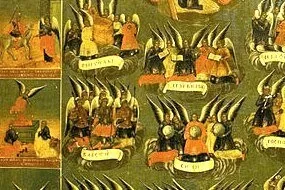 Final Thoughts on Angel Hierarchy
There are even more ideas concerning angels and their ranking that it is virtually impossible to make much sense of it all.
Ideas about angel hierarchy have been studied, researched and bantered about, over and over, by many different scholars, and one thing is clear: the rank and class of angels seem to have been evolving within religion and mythology for thousands of years. This shows us that our beliefs concerning angels change over time and across different cultures. Knowing this, we feel it best to not put a lot of stock into the various angel hierarchies; the conflicting arrangements of celestial beings reveals that someone's beliefs must be in error. And who can tell who is right, if any?
The differences in hierarchies cause us to wonder if attempts were made to make more out of ancient writings than what was initially intended by the original authors, whomever they were. Did theologians attempt to discern and assign ranks of angels from miniscule pieces of information that they be put together from different sources? Yes, in our opinion.
An example of this mixing of ideas can be better understood by visiting our Types of Angels page. You will see that so many orders of angels are equated with other angels of different names (but similar); yet there does not seem to be one hierarchy that fits all of the beliefs regarding these angelic beings. Ergo, attempts at trying to resolve the 'hierarchy confusion' seems futile.
Also study:
Angel Types
Angel Terms
Angel Names
Fallen Angel Names
Misspelling of 'Hierarchy' - note that this word is commonly spelled incorrectly as heirarchy or heirarchies.